

By Patrick Wanis, PhD
The phrase “toxic masculinity” has become one of the most overused—and destructive—terms in modern culture. Whenever a man behaves violently, abusively, selfishly, or misogynistically, the label is quickly applied: That’s toxic masculinity.
As a human behavior expert and therapist, I ask: Is it really?
No. I don’t believe so.
There is masculinity, and then there is a distorted mind driven by fear, insecurity, narcissism, entitlement, superiority, and the desire to dominate others. Those destructive qualities are not masculine. They are unhealthy, unintegrated expressions of human psychology.
Calling abusive behavior “toxic masculinity” is like calling theft “entrepreneurship.” The problem isn’t masculinity. The problem is bad character.
Masculinity has never been about controlling people or proving worth through intimidation, wealth, or material power. True strength does not arise from insecurity. Comedian Jimmy Carr offered a far simpler, healthier definition when he noted: “The cure is simple: Be a gentleman. Be a mensch.”
A gentleman treats others with respect. A mensch—a person of integrity—serves others, keeps his word, takes responsibility, and contributes to his community. Those qualities don’t eliminate masculinity; they express it.
The Vacuum of Male Identity & Toxic Masculinity
Today’s young men are searching for identity in a world giving them chaotic, contradictory messages. They are told that masculinity itself is dangerous, while simultaneously being criticized for lacking confidence, drive, or ambition.
When healthy male role models disappear, unhealthy ones fill the vacuum. Figures like Andrew Tate (currently facing extradition to the UK on child pornography charges) exploit that void. Young men aren’t drawn to influencers because they inherently crave misogyny; they are drawn because they are starving for certainty, direction, confidence, power, and a model of manhood—even if that model is profoundly flawed.
The answer isn’t to pathologize or apologize for masculinity. The answer is to understand it, clearly define it, and unapologetically embrace it.

Beyond the “Three Ps”
Media figures like Marketing Professor, Scott Galloway often promote an aspirational male code built on “The Three Ps”: Provider, Procreator, and Protector. While these represent noble responsibilities that many men willingly embrace, they do not define the essence of manhood.
Defining masculinity strictly through providing and procreating reflects a purely transactional view of men—one that frames a man’s value entirely through a utilitarian lens or a woman’s perspective. It reduces a man to a servant or success-object whose worth is measured solely by what can be extracted from him.
Consider the double standard: If we were to view a woman through the same narrow lens—insisting her femininity and worth are measured solely by her utility as a servant or her ability to birth and nurture children—we would rightly reject it as regressive and objectifying. A woman’s worth is intrinsic; it is not defined merely by her functional output.
The exact same truth applies to men.
A man without children is no less masculine. A retired man is no less masculine. A young man still finding his path is no less masculine.
Masculinity is not defined by what others can extract from you. It is defined by who you are, how you govern yourself, and the character you build. It is an internal architecture of identity, integrity, and self-efficacy. It is:
- Taking full responsibility for your choices.
- Living with integrity when nobody is watching.
- Developing emotional strength without becoming emotionally numb.
- Being disciplined enough to do what is right instead of what is easy.
- Serving something larger than your ego.
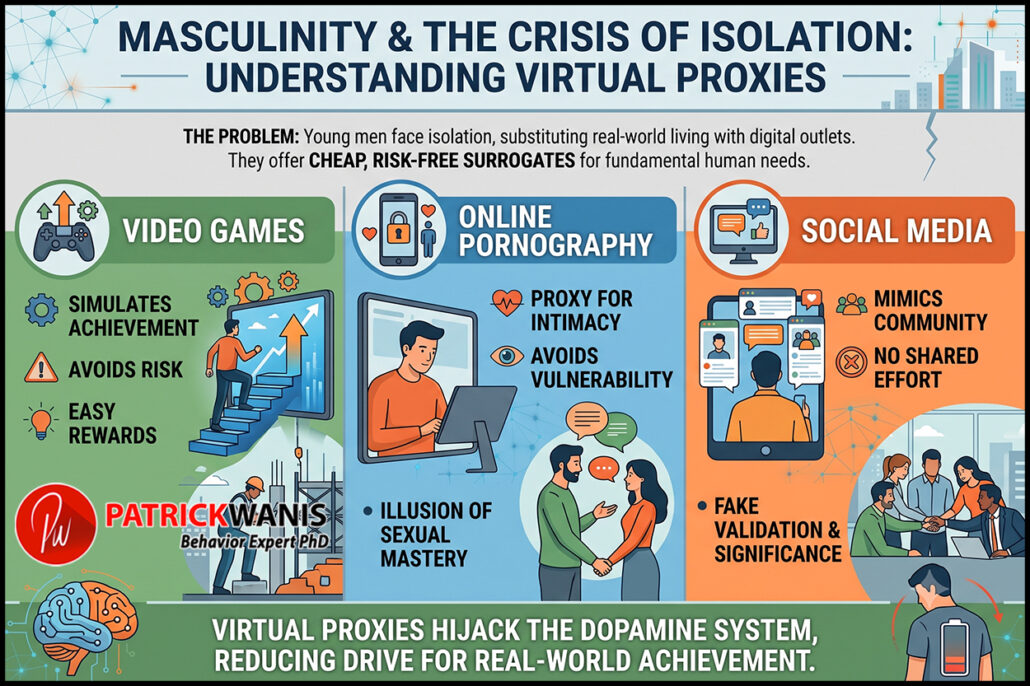
Toxic Masculinity and The Crisis of Isolation
Galloway and Carr both correctly highlight that young men are facing a crisis of isolation, substituting real-world living with video games, online pornography, and social media. Carr calls these behaviors “virtual proxies,” but that misses the underlying psychological mechanism.
These digital outlets serve a very specific purpose: they offer cheap, risk-free surrogates for fundamental human needs.
- Video games simulate the psychological drive for career, hierarchy, and achievement—offering clear goals, leveling up, and structured rewards without the terrifying possibility of real-world failure.
- Online pornography acts as a proxy for intimacy and sexual conquest. It delivers the neurochemical reward of connection and the illusion of sexual mastery while bypassing the vulnerability, effort, and fear of rejection required to approach, pursue, and win over a real woman.
- Social media mimics community, providing a false sense of belonging through superficial validation without requiring actual presence, accountability, or shared physical effort.
These virtual proxies don’t just occupy time; they hijack the brain’s dopamine system, convincing a young man’s subconscious that he has already achieved success, intimacy, and status—stripping him of the natural drive required to seek them in real life.
Community, Not Poison
Where I strongly disagree is Galloway’s suggested remedy: arguing that young men should spend more time drinking in pubs because “the risk to your liver is nothing compared to the risk of social isolation.”
While loneliness is indeed a public health crisis, recommending alcohol as the social lubricant is a dangerous misdirection. Young men don’t need more drinking; they need more authentic belonging.
We do not cure social isolation by consuming poison together. We cure it through shared purpose and real-world engagement:
- Train in a martial art or lift weights together.
- Join a sporting club or outdoor adventure group.
- Build a business, volunteer, or learn a skill.
- Gather around a campfire or share a meal.
- Find healthier ways to bond with other men, rather than drinking to escape life.
Real connection is built on shared effort, trust, and presence—not chemical sedation or a poison which can destroy your life as much as it can destroy your health.
The True Measure of a Man
Ultimately, masculinity is not something to apologize for or eradicate. It’s to be welcomed and developed.
The strongest men don’t make others feel smaller; they make others feel safer. They don’t seek superiority over others; they seek significance within themselves. They don’t demand respect; they demonstrate good character and earn respect.
A real man continually becomes the best version of himself—and in doing so, empowers those around him to do the same.
True strength begins on the inside. Schedule a private session with Dr. Patrick Wanis today to master your internal psychology, overcome isolation or self-defeating habits, and develop the unshakable character needed to thrive in your relationships, career, and personal life.

Patrick Wanis, PhD, is a renowned relationship and behavioral expert with over 25 years of experience. Creator of SRTT Therapy (Subconscious Rapid Transformation Technique), he specializes in resolving root causes of trauma and other conditions without reliving pain or retraumatization. He has developed various psychological assessments on emotional intelligence, relationships, self-sabotage, and authenticity, and serves diverse clients from celebrities to teens. A trusted media source, Global media including CNN, BBC, FOX News turn to Wanis for insights into relationships, sexuality, human motivation, trauma, communication, body language, and persuasion.