
By Patrick Wanis, PhD
Have you experienced nagging in your marriage? Here’s how it plays out and fails.
It’s such a common experience: a couple comes to me for help, but one partner—frequently the wife—isn’t seeking reconciliation. She is seeking vindication.
She comes with her list of grievances, essentially wanting a professional referee to validate her, turn to her husband, and say: “You’re completely wrong. Your wife is an angel, and every problem in this marriage is entirely your fault. You need to change!”
Thus, there is a distinct refusal to accept any form of personal accountability or responsibility. There’s no willingness to ask the fundamental question that every relationship requires, particularly when that relationship is suffering: “What am I doing to contribute to the dysfunction in this marriage?”
Instead, when anger, frustration, and stress mount, many women default to a strategy they believe will eventually work if they’re just relentless: nagging.
The Myth of Nagging: Demanding Obedience vs. Cultivating Intimacy
There is a common, destructive belief in struggling relationships: “If I keep criticizing him, shouting at him, ridiculing him, and putting him down, he will eventually realize he’s wrong and change.”
In the movie Knocked Up, two married women discuss their marital frustrations, with one suggesting that the secret to getting a husband to change is simply to keep nagging him until he gives in.
The exchange takes place between Debbie (played by Leslie Mann) and her sister Alison (played by Katherine Heigl) in a bedroom while eating ice cream:
Debbie: “You need to train him. Oprah said that when two people meet, they should point out each other’s differences and flaws.”
Alison: “I thought you should love people for who they are.”
Debbie: “You criticize them a lot, so they get so down on themselves they have to change.”
Alison: “You don’t think that’s naggy?”
Debbie: “In the end, they thank you for it.”
But in real life, nagging is not a communication tool nor leverage. Instead, it’s an attempt to exert control over someone who feels non-responsive, and no, they don’t thank you for the nagging!
When a woman constantly criticizes, directs, and corrects her husband, she unconsciously steps out of the role of an adult partner and into the role of a mothering figure. She treats her husband like a child, operating under the assumption that if she nags enough, he will obey.
The fatal flaw: Nagging assumes obedience, not intimacy
You cannot nag a man into loving you, respecting you, or desiring you—you can only nag him so much that he will resentfully comply or he will totally withdraw emotionally.

Why Women Default to Words—and Why Nagging Destroys Relationships
Why do so many women default to nagging when a relationship gets rocky?
Boys and girls learn to handle conflict on the playground in different ways.
When young boys get angry or fight for position or hierarchy, their aggression is usually physical and direct. They push, wrestle, or throw a punch. It’s loud, fast, and obvious. A winner is established, and five minutes later, they’re usually all back to playing together.
Words & Nagging Are Their Ultimate Weapon
Young girls, on the other hand, fight in a completely different way. Because physical fighting isn’t socially acceptable or safe, girls learn early on that words are their ultimate weapon. They navigate power, boundaries, and conflict through language—using gossip, exclusion, sharp critiques, or emotional pressure. Words become their primary tool to get what they want and to keep control.
They’ll do the same in adulthood: when a woman feels anxious, powerless, or unsupported in her marriage, she doesn’t use her fists. She defaults to the tool she knows best and has used her entire life: her voice.
When she feels her husband slipping away or ignoring her needs, her anxiety spikes. If a quiet request doesn’t work, she repeats it. And yes, perhaps she’s asked reasonably ten times and the husband hasn’t responded. When that still doesn’t work, she cranks up the volume and emotional intensity—shifting from simple requests to criticism, sarcasm, and nagging. Subconsciously, she thinks: “If I just keep talking, repeating myself, and pointing out where he’s wrong, he will finally get it and change.”
Why Nagging Fails: The Tragedy Of The Nagging Mindset
While repeating yourself over and over again might eventually get a six-year-old child to clean his room, it completely ruins a marriage.
Nagging treats a man like a child who needs to be managed and controlled, rather than a partner who needs to be respected. It swaps emotional intimacy for forced obedience. Instead of bringing a couple closer together, it turns the marriage into an exhausting battle of attrition – gradual wearing down, weakening, and exhaustion through consistent pressure: The wife becomes the nagging mother, the husband shrinks into the defiant son, and both end up completely miserable, detesting each other, isolating, and ultimately drowning in contempt.
Note: Accountability must work both ways. Her frustration may be legitimate but the nagging doesn’t succeed in improving the relationship.
The Destructive Cycle of Nagging: Negation, Shrinking, and Isolation
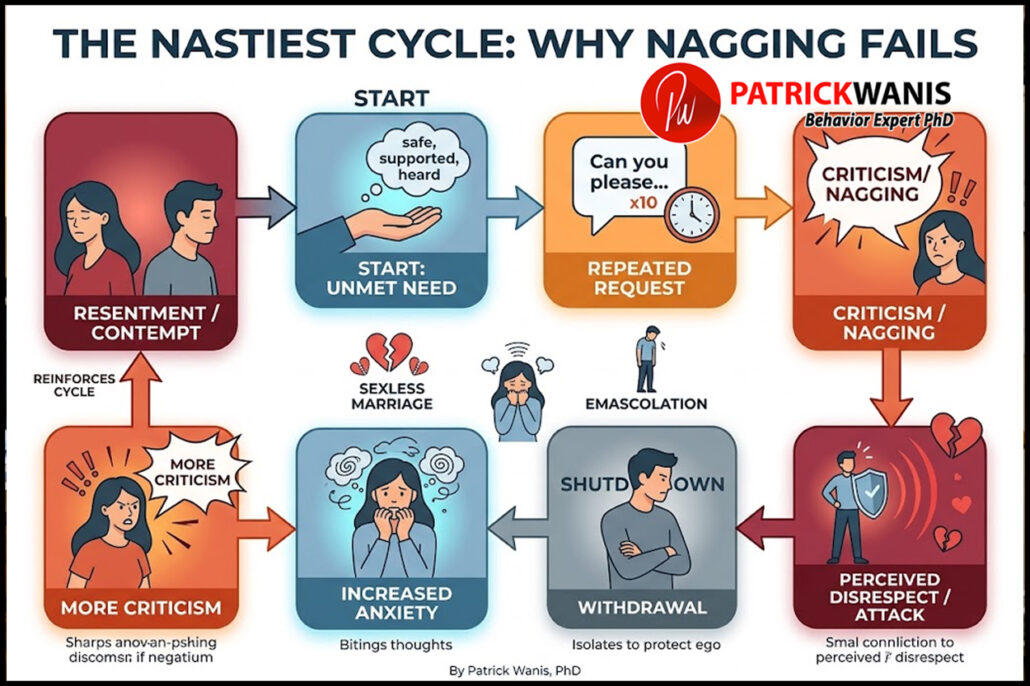
When a relationship falls into this trap, a vicious neurological and emotional cycle takes over:
- The Verbal Attack: The wife uses criticism, sarcasm, and emotional invalidation to express her frustration. She’s constantly telling him, “You’re wrong. You’re not enough.”
- The Nervous System Response: Men are particularly sensitive to feeling negated, criticized, or disrespected by their partner. When constantly attacked, he experiences physiological flooding—his brain registers a threat – rejection, disrespect and failure.
- Shrinking & Isolation: Rather than “realizing he’s wrong,” the husband’s confidence shrinks. He feels small and worthless around her, and thus, to protect himself from further emotional harm, he isolates, retreats, and shuts down (often withdrawing sexually and emotionally.)
- The Complete Shutdown of Sexual Intimacy: The sexual death of the marriage happens from both sides. As the husband retreats and isolates sexually to protect his ego from constant attack, the wife also shuts down sexually. She loses desire for a man she has to “mother” and manage, or she begins withholding sex out of resentment and a desire for leverage. Now, physical connection—the very thing that could bridge the emotional gap—is completely severed by both partners – it’s become a sexless marriage.
- Escalation & Contempt: The wife views his retreat as proof that he doesn’t care, causing her to escalate her criticism. Over time, this emotional chasm turns into deep-seated resentment and, ultimately, contempt—the single greatest predictor of divorce.
The Two Core Needs: What Men and Women Actually Require
At the heart of this breakdown is a fundamental misunderstanding of the primary emotional needs that drive emotional safety for men and women in a partnership:
- What a Woman Needs: A woman needs to feel safe, supported, and heard. When she feels unsupported, anxiety kicks in, and she attempts to regain control through criticism.
- What a Man Needs: A man needs appreciation, respect, and validation. When he is constantly told he is wrong, he loses the motivation to engage in the relationship altogether. He feels emasculated.
Women possess immense power in a relationship—not through criticism, but through their ability to build up their partner. When a man feels genuinely respected and appreciated by his wife, he’s naturally motivated to step up, protect, and support her. When he is constantly negated, he simply walks away. We all move toward what builds us up and away from what tears us down!
Breaking the Cycle of Nagging: Moving from Blame to Accountability
Are you stuck in a loop of constant criticism and emotional distance?
Real transformation begins when both partners stop trying to win the argument and start taking responsibility for their emotional output:
- Shift from Criticism to Request: Criticism attacks a person’s character (“You are lazy and selfish”). A clear, respectful request focuses on a specific need while preserving your partner’s dignity – “I’m feeling overwhelmed with things around the house right now, and I would really appreciate your help with…”
- Step Out of the “Parent-Child” Role: Stop treating your partner like a subordinate who needs to be managed, directed, corrected or controlled. Speak to them as an equal adult.
- Practice Appreciation: Acknowledge what your partner is doing right before demanding what needs to change. Validation builds a bridge; criticism burns it down.
- Accept Personal Accountability: Ask yourself: “Am I trying to solve this problem, or am I just trying to prove that I am right and my partner is wrong?” What do you truly gain by being right if it destroys your partner and marriage?
A healthy marriage is not built on obedience or tearing down your partner in order to be vindicated. A healthy partnership is built on mutual respect, emotional safety, and the courage to look in the mirror and own your role in the outcome. Schedule a session with me if you need assistance or guidance.

Patrick Wanis, PhD, is a renowned relationship and behavioral expert with over 25 years of experience. Creator of SRTT Therapy (Subconscious Rapid Transformation Technique), he specializes in resolving root causes of trauma and other conditions without reliving pain or retraumatization. He has developed various psychological assessments on emotional intelligence, relationships, self-sabotage, and authenticity, and serves diverse clients from celebrities to teens. A trusted media source, Global media including CNN, BBC, FOX News turn to Wanis for insights into relationships, sexuality, human motivation, trauma, communication, body language, and persuasion.