
Why You Keep Repeating the Same Patterns in Love, Life, and Success
By Patrick Wanis, PhD
What truly controls your choices? Which hidden part of your mind makes decisions that sabotage the very things you desire most?
Why do intelligent, capable people repeatedly choose the wrong romantic partners? Why do high achievers sabotage their success just as they reach the finish line? And why do so many remain trapped in anxiety, procrastination, self-doubt, or heartbreak—despite genuinely wanting to change?
For decades, popular psychology has focused almost exclusively on conscious thoughts, willpower, and behavioral habits. Yet the vast majority of what drives our daily lives happens far beneath conscious awareness.
Your subconscious mind is constantly interpreting experiences, assigning meanings, protecting you from perceived emotional danger, and guiding your decisions, feelings, and relationships. It isn’t trying to make your life difficult. In fact, it is always trying to help you—but often using outdated strategies that were learned years, or even decades, earlier in childhood.
After working with thousands of clients around the world, I recognized that the exact same hidden mechanisms kept appearing, regardless of whether someone sought help for heartbreak, chronic anxiety, low self-esteem, addiction, trauma, or relationship conflict.
These patterns are not random. They reflect universal laws governing how the subconscious mind operates.
Understanding these laws fundamentally shifts the question from a shaming, “What’s wrong with me?” to something far more empowering:
“What is my subconscious mind trying to accomplish?”
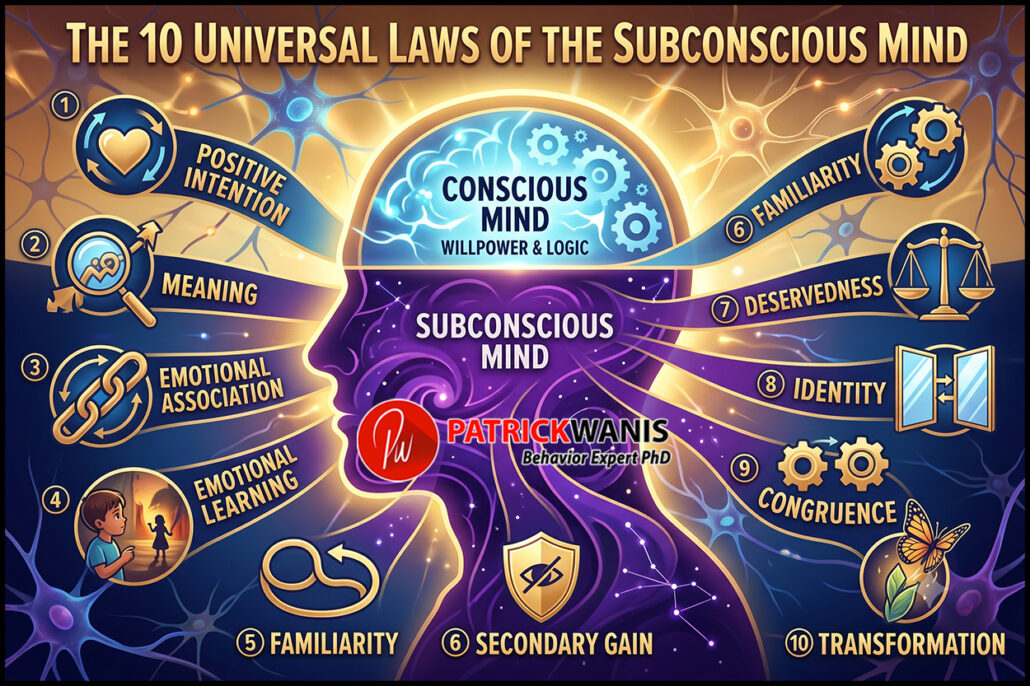
The 10 Universal Laws Of The Subconscious Mind that form the foundation of my work:
- The Law of Positive Intention
Your subconscious mind always has a positive intention. Every emotion, behavior, or habit—even those that seem self-destructive—is attempting to protect you, meet a core emotional need, or help you avoid pain. The problem is rarely the underlying intention; it is the outdated strategy.
- The Law of Meaning
Events do not determine your emotional experience. The meaning your subconscious mind attaches to those events does. Two people can experience the exact same breakup, rejection, or professional setback and respond completely differently because they assign entirely different meanings to the experience.
- The Law of Emotional Association
Your subconscious mind rarely becomes attached to people or material possessions themselves. It becomes attached to what they represent—love, safety, belonging, certainty, significance, identity, or hope. Understanding these emotional associations explains why letting go can feel so difficult.
- The Law of Emotional Learning
The subconscious mind learns most powerfully through emotionally significant/intense experiences. Childhood events, repeated emotional dynamics, and highly charged moments become the internal blueprints through which all future experiences are interpreted.
- The Law of Familiarity
Your subconscious mind prefers what feels familiar over what is objectively healthy. This is why people often repeat painful relationship patterns, tolerate toxic situations, or resist positive change. Familiarity creates predictability—and predictability feels safe to the nervous system.
- The Law of Secondary Gain
If a painful emotional pattern or behavior continues, your subconscious mind usually believes it serves a hidden, protective purpose – a secondary gain. Your anxiety, heartbreak, perfectionism, or procrastination may be acting as a shield against an even greater fear. Lasting change begins when you uncover that hidden purpose and discover healthier ways to fulfill it.
- The Law of Deservedness
In 2006, I introduced what I call The Law of Deservedness:
“You only get what you subconsciously believe you deserve and no more; and if you get more, you will sabotage it, push it away, or you simply won’t enjoy it.”
Many people consciously desire love, success, and happiness while subconsciously feeling unworthy of receiving them. Until that subconscious belief changes, life will continually reflect those invisible limits, and you’ll somehow keep returning to the baseline of what you subconsciously believe you deserve. Read more and listen to the audio interview on Law of Deservedness.
- The Law of Identity
Your subconscious mind works tirelessly to protect your self-concept. If you unconsciously identify as “the abandoned one,” “the people pleaser,” “the failure,” or “the rescuer,” your subconscious will continually generate experiences that reinforce that identity. Transforming your life requires transforming the identity beneath your behaviors.
- The Law of Congruence
The subconscious mind constantly seeks consistency between your beliefs, emotions, identity, and life experiences. When these are out of alignment, psychological tension arises. Genuine transformation occurs when your subconscious beliefs become congruent with the life you consciously want to build.
- The Law of Transformation
Nothing your subconscious mind has learned is permanent. Beliefs, emotional associations, protective strategies, and identities can all be updated – this is neuroplasticity. Real transformation doesn’t occur through force or willpower alone. It happens when your subconscious mind recognizes that the old strategy is no longer necessary and adopts a healthier way to meet the same need.

Moving Beyond Willpower With The 10 Universal Laws Of The Subconscious Mind
These laws have shaped my clinical work with clients for more than three decades. They form the foundation of my Subconscious Rapid Transformation Technique (SRTT) and my programs on relationships, self-worth, emotional healing, and human development.
When you understand these ten universal laws of the subconscious mind, you begin to see your entire life through a completely different lens. You stop asking, “Why do I keep doing this?” and instead ask, “What is my subconscious mind trying to protect, preserve, or achieve?”
That single shift in perspective transforms self-blame into understanding, frustration into curiosity, and suffering into a powerful opportunity for growth.
Trauma, Addiction, Shame and The 10 Universal Laws Of The Subconscious Mind
Addiction and trauma are deeply rooted in the subconscious mind’s attempts to cope with overwhelming emotional pain, operating directly through the Law of Emotional Learning and the Law of Secondary Gain. When early trauma instills a hidden belief of unworthiness or shame, the Law of Deservedness takes over—dictating that you can only receive, tolerate, or sustain the level of peace and love you subconsciously believe you deserve. As a result, addictive behaviors or emotional numbing often become subconscious protection mechanisms, shielding you from the unbearable feeling that you are fundamentally broken. True recovery begins not by fighting the addiction with conscious willpower, but by healing the underlying trauma, transforming shame, and expanding your subconscious sense of deservedness so you can safely allow health, self-worth, and lasting peace into your life.
If you are ready to stop repeating the same painful loops and finally update the outdated strategies running your life, you don’t have to navigate this journey alone.
Through a private, targeted Subconscious Rapid Transformation Technique (SRTT) session, we work directly at the root level—uncovering the exact laws driving your patterns, updating your subconscious meanings, and unlocking true emotional freedom without relying on willpower alone.
Because lasting change doesn’t begin by fighting your subconscious mind.
It begins by understanding it and transforming it.
Click Here to Book Your Private SRTT Session Today

Patrick Wanis, PhD, is a renowned relationship and behavioral expert with over 25 years of experience. Creator of SRTT Therapy (Subconscious Rapid Transformation Technique), he specializes in resolving root causes of trauma and other conditions without reliving pain or retraumatization. He has developed various psychological assessments on emotional intelligence, relationships, self-sabotage, and authenticity, and serves diverse clients from celebrities to teens. A trusted media source, Global media including CNN, BBC, FOX News turn to Wanis for insights into relationships, sexuality, human motivation, trauma, communication, body language, and persuasion.