

Parents become their child’s external nervous system.
As a parent, you probably often worry about what you say to your children, particularly when trying to prevent childhood anxiety. And yes, words are powerful. However, neuroscience reveals that there is something even more important.
Your child is constantly learning from your nervous system.
Long before children can regulate their emotions, calm themselves, or make sense of overwhelming experiences, they rely on the adults around them to do it for them. In other words, before children learn to regulate themselves, they first learn to regulate through you.
This isn’t simply a psychological theory. It’s how the developing brain is designed.
The nervous system is the body’s communication and survival system. Its primary role is to constantly monitor both the external world and the internal body, asking one essential question: “Am I safe?” The answer to that question influences everything—from our heartbeat and breathing to our thoughts, emotions, and behavior. And it begins with the amygdala.
The Anatomy of Fear: The Amygdala vs. The Prefrontal Cortex
When a young child becomes frightened, overwhelmed, or distressed, the amygdala—the brain’s threat detection system—activates immediately. The amygdala is constantly scanning for danger and asking, “Am I safe?”
The medial prefrontal cortex, located just behind the forehead, performs a very different role. It helps us think clearly, regulate emotions, evaluate whether a threat is real, and calm the amygdala when there is no actual danger.
The challenge is that this regulating part of the brain is still developing throughout childhood and adolescence, reaching full maturity only in a person’s mid-twenties. Accordingly, young children simply do not have the neurological capacity to consistently calm themselves.
Nature solved this problem in a remarkable way: Parents become their child’s external nervous system.
Think of it this way: before your child develops the neurological ability to calm themselves, they borrow yours. Your calm nervous system helps regulate theirs until their own brain becomes capable of doing the job independently. (Read the research demonstrating how a mother’s presence directly quiets a child’s amygdala, acting as an external prefrontal cortex.)
The Biological Blueprint of Connection
Every experience your child has with you leaves a biological imprint on their developing brain. Neuroscientists refer to this as experience-dependent neuroplasticity – the brain’s remarkable ability to change its physical structure and function in response to repeated experiences.
Imagine walking through a dense forest. The first time, there is no obvious path. You push through branches, step over rocks, and make your own way. But every time you walk the same route, the path becomes wider, clearer, and easier to follow. Your child’s brain develops in much the same way. Every repeated emotional experience strengthens the neural pathways associated with that experience. A child who repeatedly experiences safety develops stronger pathways for emotional regulation. A child who repeatedly experiences fear or unpredictability repeatedly activates the brain’s survival circuitry. Over time, those frequently activated neural pathways become stronger, more sensitive, and increasingly hyper-reactive, making the nervous system progressively more vigilant and more likely to perceive threat even when none exists.
- Every moment of comfort, emotional attunement, safety, and connection strengthens the neural circuits that support lifelong resilience. Read the study that proved a parent’s physical presence, like holding a child’s hand, instantly dampens neural activity in the threat centers of the brain during an adverse event.
- Repeated experiences of fear, unpredictability, or chronic stress repeatedly activate the brain’s survival circuitry, making those pathways stronger and more efficient.
Thus, the architecture of your child’s brain is not determined solely by genetics; it is continuously being shaped by relationships.
Developmental psychologists call this process co-regulation—the parent helping regulate the child’s nervous system until the child gradually internalizes those skills. Before children can regulate themselves, they first learn to regulate through a calm, emotionally available caregiver.
When you pick up your frightened toddler, comfort your child after a nightmare, soothe them when they are overwhelmed, or remain calm while they are having a meltdown, your nervous system is lending them the emotional regulation they cannot yet provide for themselves.
That’s right: your internal emotional state acts as a biological mirror for your child’s nervous system.
Your internal emotional state becomes the template from which your child’s nervous system learns what is safe and what is dangerous. They absorb your emotions, even when you say or do nothing at all.
Children don’t inherit only their parents’ genes—they also inherit their parents’ emotional environment. Children are not simply raised by our words. They are shaped by our emotional state.
Neuroscientists reveal that this kind of responsive caregiving strengthens the neural pathways connecting the amygdala and the prefrontal cortex. Gradually, children internalize what they first experienced through you. They learn:
- “I can feel afraid without being in danger.”
- “I can feel overwhelmed without losing control.”
- “Big emotions eventually settle.”
How Chronic Stress Programs the Brain for Anxiety
The opposite process also occurs. If a child’s world is chronically unpredictable, or if their caregiver is emotionally unavailable, highly critical, frightening, or neglectful, the developing nervous system adapts purely for survival.
The amygdala becomes hyper-reactive, sounding the alarm at the slightest provocation. The nervous system remains on permanent alert, hyper-vigilance becomes the default setting, and the brain begins anticipating danger even when no danger exists.
Recent cellular mapping published in Molecular Psychiatry shows that early-life environmental stress fundamentally alters the electrical signal flow between the prefrontal cortex and the amygdala, rewiring the brain and trapping the nervous system in a chronic state of survival mode.
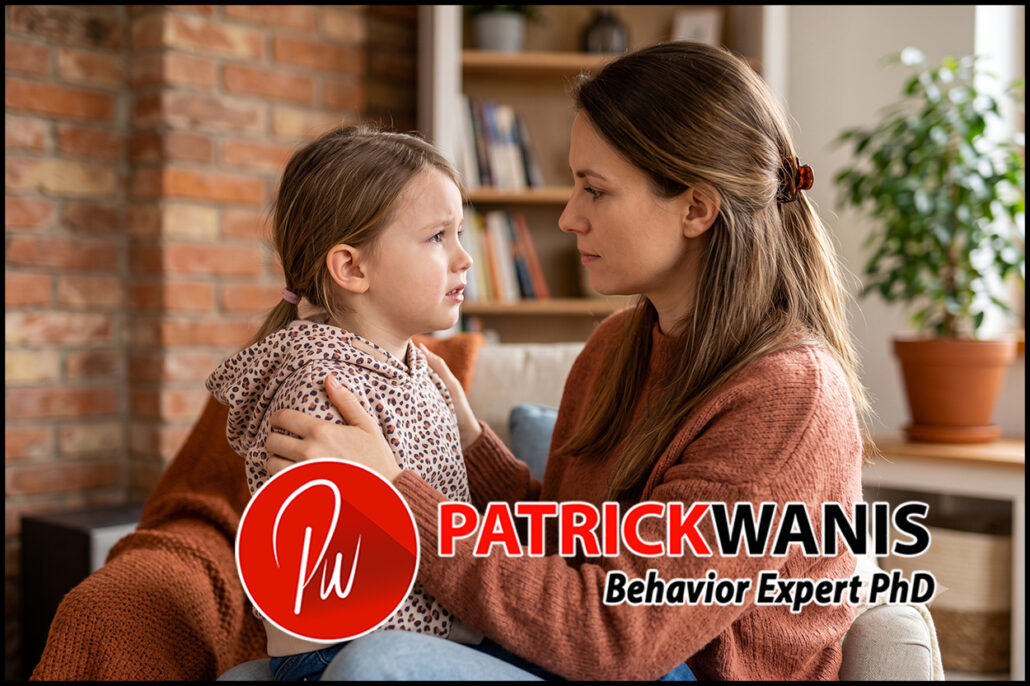
This is where childhood anxiety often begins.
For decades, I have taught my clients that anxiety is the feeling or belief that your world is out of control, coupled with the attempt to control that which you can’t control. Viewed through the lens of neuroscience, this definition makes perfect sense. In other words, anxiety is a nervous system trying to create certainty in an uncertain world.
A nervous system that constantly expects danger tries to regain safety by predicting, controlling, avoiding, overthinking, pleasing others, or preparing for every possible worst-case scenario. Ironically, the harder we try to control what is beyond our control, the more anxious we become.
The problem isn’t that the nervous system is broken.
It’s doing exactly what it learned to do to survive an unpredictable environment. What once helped the child survive, later becomes chronic anxiety in adulthood. This is also why superficial, modern wellness trends like a temporary ‘nervous system reset’ completely miss the mark when it comes to true, root-cause healing.
Anxiety is the feeling or belief that your world is out of control, coupled with the attempt to control that which you can’t control. Viewed through the lens of neuroscience, this definition makes perfect sense. In other words, anxiety is a nervous system trying to create certainty in an uncertain world.
How to Build a Child’s Nervous System That Resists Anxiety
Fortunately, neuroplasticity works both ways. If you want to strengthen the brain’s emotional regulation center, your child needs to repeatedly experience safety, connection, and emotional co-regulation.
Every time your child becomes frightened, overwhelmed, frustrated, or disappointed, you have an opportunity to shape those neural pathways:
- When you remain calm instead of becoming emotionally reactive, your nervous system communicates, “You are safe.”
- When you help them understand their emotions rather than dismissing, shaming, or escalating them, you are teaching their prefrontal cortex how to guide the amygdala.
These aren’t isolated moments. They are repetitions. And the brain learns through repetition and intense emotional states. Research shows that a calm, emotionally available parent becomes the child’s biological safety net, teaching a young child’s developing nervous system how to tell the difference between a real threat and temporary distress.
Over months and years, these learning experiences help children build their own internal calm. Eventually, they develop a core belief embedded within their nervous system:
“The world isn’t always comfortable, but I can handle it.”
The Power of Repair: Why You Don’t Need to Be Perfect
The point here is not that you need to be a perfect parent, and you don’t need to be calm all the time or respond perfectly every single day. Children don’t need perfection; they need emotional safety, consistency, and repair.
Every relationship experiences moments of frustration, conflict, and disconnection. What matters most is what happens after.
An apology, a reconnection after a fight, or helping a child process difficult feelings teaches the developing nervous system that emotional distress is temporary, relationships can recover, and safety can always be restored.
Those experiences teach a child that uncomfortable emotions can be tolerated and resolved rather than feared or avoided. One of the greatest gifts you can give your children is a regulated nervous system that experiences the world as fundamentally safe.
Remember that when children learn safety early in life, they won’t spend adulthood trying to control a world that was never meant to be controlled.
The encouraging news is that while these patterns are established in childhood, the brain remains capable of change throughout life. Through neuroplasticity and effective therapeutic approaches such as SRTT, even deeply ingrained patterns of anxiety and hypervigilance can be transformed.

Patrick Wanis, PhD, is a renowned relationship and behavioral expert with over 25 years of experience. Creator of SRTT Therapy (Subconscious Rapid Transformation Technique), he specializes in resolving root causes of trauma and other conditions without reliving pain or retraumatization. He has developed various psychological assessments on emotional intelligence, relationships, self-sabotage, and authenticity, and serves diverse clients from celebrities to teens. A trusted media source, Global media including CNN, BBC, FOX News turn to Wanis for insights into relationships, sexuality, human motivation, trauma, communication, body language, and persuasion.